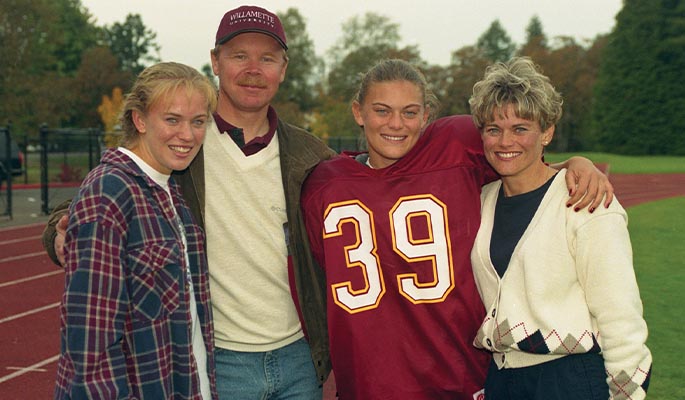
Media from coast to coast are abuzz this week about Willamette University alumnus Nick Symmonds’ exciting win in the men’s 800-meter final at the U.S. Olympic Track and Field Trials. Symmonds ’06, running for the Oregon Track Club/Nike, ran a… < full story >
| July 7th | |
| 2:00pm | Traditional Japanese Tea Ceremony |
| July 9th | |
| 4:45pm | Yoga Circle |
“Sometimes I get asked why I changed my major from biochemistry to philosophy,” says Jacob Swenson ’07, who recently received an American Graduate Fellowship. “But if you ask ‘Why’ long enough, even your organic chemistry professor will eventually point you to the philosophy department.”
After Swenson chanced upon Philosophy 101, “it was the beginning of the end” for his well-laid career plans. He had wanted to work as a physician. “I came to realize the power of medicine,” Swenson says of two stints in Senegal, West Africa, where volunteer activities included work in a rural medical clinic.
Swenson co-authored and published a paper in a professional science journal and orchestrated student visits to local schools with the Willamette Chemistry Club, demonstrating science experiments for children. “We hoped to ignite student interest through substantial — and exciting— chemical reactions,” he says.
But he was becoming increasingly consumed by philosophical questions, even lugging his well-thumbed philosophy books back to Senegal for his second visit. “It was kind of weird. Every night my Senegalese family and I would gather on the porch around the TV. While they watched soap operas, I read Kierkegaard’s Fear and Trembling.”
Back at Willamette, Swenson read Immanuel Kant’s Critique of Pure Reason in the chemistry lab as the centrifuge spun and joined in late-night discussions with the Philosophy Club. And then led discussions. And then organized a film group that discussed the philosophical and theological themes of films. Classes in philosophy and reading groups in the park jostled with required science courses and lab schedules.
“Eventually, I realized I had a deeper passion for philosophy than for science. Philosophy was the best place for me to explore the questions that fascinated me,” he says.
“I can’t think of any better training for philosophy than science, with its tight structure and clarity. As a science student, I was concerned with understanding precisely how physical processes came about, but philosophy introduced me to an entirely disparate set of questions about the self, God and values. These questions, it seems to me, extend beyond the scope of empirical science. For example, we can’t think of God as located in time and space. If we did, we would be on a wild goose chase. Similarly, we cannot answer questions about what is good or beautiful through scientific experimentation. Just imagine trying to design a scientifically sound test to determine what one should do when faced with a particular ethical dilemma, like lying to protect a friend.
“Philosophy students are trained to think about the world in the broadest possible sense. Every discipline has its theory and ground rules. In a connected and rapidly changing world, it is important to sit back and analyze the wider picture. And you need to navigate between different fields and transcend traditional boundaries. Philosophy gives you those skills.”