Study Physics

Explore the forces that shape our universe and collaborate with professors on cutting-edge research. Choose a physics major and pursue groundbreaking research.

Program Snapshot

Undergraduate Bachelor of Arts, Undergraduate Bachelor of Science

Major, Minor

124

4 Years

Salem

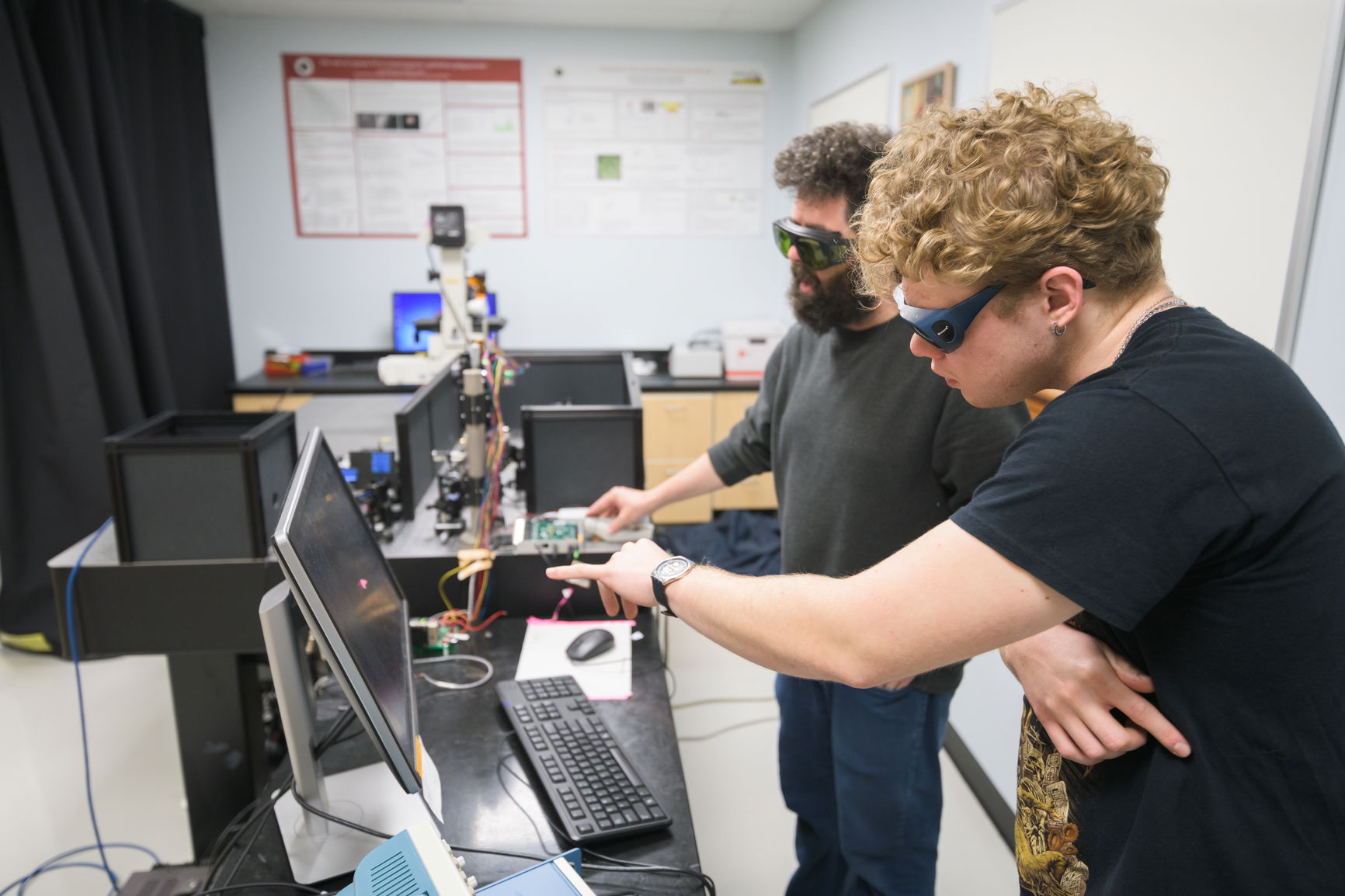
A professor talking about scientific results of a tool with two other students

Our Physics Major & Minor

Learn fundamental theories and apply them to hands-on research opportunities. Find professors that will mentor, inspire, and challenge you at every level. Explore our physics degree to prepare for graduate programs and scientific careers.

Why choose Physics at Willamette?

  • We support your career interests. Whether you want to pursue a career in physics, engineering, math, or data science, Willamette offers the right resources. Connect with faculty members, academic advisors, and research projects to find your ideal path.
  • Find support outside the classroom. From physics club to tutoring opportunities, students can find support from their peers. Willamette offers a friendly and collaborative community that supports your academic journey.
  • Gain real-world research experience. We require physics majors to spend at least a full year of independent research in one of our research laboratories. Find internships and research projects on and off campus to develop your skills and make an impact.

Schedule a Visit

Request Information

Do you have questions about the Physics program at Willamette? Fill out this form and we'll get in touch!

Loading...

Although Hannah Rarick '21 discovered Willamette through a music scholarship, the supportive and tight-knit community on campus led her to a career in physics. Small class sizes, one-on-one mentorship, and an expansive network gave her the tools to gain experience and build confidence in a new field.

Hannah's Story

Research, faculty boost grad’s success in physics

The faculty and resources at Willamette connected Hannah with opportunities to participate in hands-on learning. Exploring events through Conferences for Undergraduate Women in Physics allowed her to build connections across the country and Research for Undergraduates gave her the opportunity to work with The Young Lab in Pennsylvania.

View Story
Hannah Rarick
When Hannah started at Willamette, she was not confident in her understanding of physics. She credits and the support and guidance she received from faculty members with helping her level up her knowledge and setting her on a path toward a meaningful career.

Opportunities Beyond the Classroom

Curious where this major can take you? These are the real internships, graduate opportunities, and careers our Physics students have gone on to.

  • Willamette physics students studying in a lab

    Internships

    • Areté Associates
    • Brookhaven National Laboratory
    • Case School of Engineering at Case Western Reserve University
    • Center for Human Machine Systems in Rehabilitation Engineering
    • CrowdStreet
    • FAMU-FSU College of Engineering
    • Institute of Science and Technology Austria
    • Mayo Clinic
    • NASA Jet Propulsion Laboratory
    • Pacific Northwest National Laboratory
    • Qorvo, Inc.
    • REU Sites Program
    • State of Oregon – Department of Consumer and Business Services
    • Texas A&M University Cyclotron Institute
    • The Institute of Scientific and Industrial Research, Osaka University
    • Thermo Fisher Scientific
  • Willamette physics student studying in a lab

    Graduate School Destinations

    • Columbia University
    • Harvard University
    • Lehigh University
    • Oregon Health & Science University
    • Oregon State University
    • Tufts University
    • UCLA
    • University of Chicago
    • University of Colorado, Boulder
    • University of Maryland
    • University of Oregon
    • University of Virginia
    • Purdue University
    • Vanderbilt University
    • Washington University McKelvey School of Engineering
  • Willamette physics students studying in a lab

    Employment Outcomes

    • Design for Extreme Affordability
    • Indicio.tech
    • iRobot
    • Knox Data Co Ltd
    • Lam Research
    • Lawrence Livermore National Laboratory
    • National Science Foundation
    • SpaceX
    • Stowers Institute for Medical Research
    • UW Health
    • University of Washington
    • WashU Racing

Alumni Stories

As a top physics program, our alumni find success wherever they go. Physics graduates join the best graduate schools and explore career paths in physics, engineering, and even computer science. Alumni pursue careers in a wide range of fields, including acoustics and quantum computing.

  • Woman in a gray knit sweater and blue stone necklace, sitting indoors with blurred background including blue and brown walls.

    Elisa Ahern ’15

    Willamette Physics student earns Fulbright scholarship
    Elisa Ahern ’15, a Fulbright scholarship recipient, mentored young girls in science, led the German club, participated in athletics, and worked as a teaching assistant and tutor; she received a master’s in bioinformatics and has interests in the bioinformatics industry and teaching.

Introducing Some of Our Faculty

Our physics department boasts insightful faculty members who are actively contributing to the physical science world. Through important research opportunities and small class sizes, physics students can gain the knowledge they need to make an impact.

  • Meet Professor Watkins

    Dr. Richard Watkins is deeply immersed in astrophysics, cosmology, and particle physics. By studying the cosmos, he seeks to unveil the distribution and evolution of matter in the universe, shedding light on complex phenomena for his students.

    Headshot of Dr. Richard Watkins
  • Meet Professor Altman

    Dr. David Altman is engaged in understanding the intricate dynamics within cells. He probes microscopic engines in the cell using lasers and microscopes.

    Headshot of Dr. David Altman
  • Meet Professor Borrero

    Dr. Daniel Borrero brings real-world experience and innovative teaching methods to the classroom. Students in his courses benefit from his interdisciplinary approach to hands-on experiments using cutting-edge technology, and a curriculum designed to foster deep understanding and practical skills in physics.

    Headshot of Dr. Daniel Borrero

Curriculum

Build an apparatus to investigate chaos or wield lasers to explore the inner workings of molecular motor proteins. Gain hands-on experience with computational science techniques, using simulations and modeling to explore and understand complex physical phenomena. Become fluent in Python and join open-ended research projects. Explore advanced and introductory course options.

  • PHYS 340 Advanced Data Analysis and Simulation

    Master advanced data analysis methods essential for cutting-edge physics research, using Python for exercises and simulations. Work on real-world projects, covering topics like Bayesian estimation, Monte Carlo techniques, and machine learning.

  • PHYS 495W Research Seminar I

    Design and conduct individual research projects with faculty mentorship, enhancing your research and scientific communication skills. Through seminars, mentoring, and thesis writing, students will culminate their coursework with a presentation of their progress report.

Program Requirements

Our Bachelor of Arts Physics program requires 57 semester hours to complete the major, with a total of 124 credit hours required to complete the degree. This is comprised of 39-45 semester hours in Physics, 8 semester hours in Mathematics, 4 semester hours in Computer Science, and up to 9 semester hours in allied disciplines.

Our Bachelor of Science Physics program requires 57 semester hours to complete the major, with a total of 124 credit hours required to complete the degree. This is comprised of 45 semester hours in Physics, 8 semester hours in Mathematics, and 4 semester hours in Computer Science.

Students pursuing a Physics minor will need to complete 23 semester hours in select Physics courses.

A student looking at results with a professor on a computer from a microscope

Admissions Information

Our Physics program is open to first-year students, transfer students, and international students. Learn more about Willamette’s undergraduate admissions process to get started.

Two young men examining a mechanical component in a workshop setting.

Financial Aid and Scholarships

Willamette University offers generous merit scholarships and financial aid to Physics majors, with no separate application required. All admitted undergraduates are automatically considered for scholarships starting at $28,000 per year. For students with financial need and a passion for STEM, our STEM Fellows Program provides up to $5,000 annually for first-year students. This program includes mentorship, field trips, tutoring, and more, helping students succeed in their STEM careers.

A student test using equipment in a physics lab

FAQs

A physics degree equips you with a versatile skill set that allows you to pursue various paths. With a physics degree, you can:

  • Conduct Research: Engage in fundamental or applied research in academic, government, or industrial settings to advance scientific knowledge and technological innovations.
  • Develop Technologies: Apply your understanding of physical principles to create and enhance technologies in fields like renewable energy and nanotechnology.
  • Analyze Data: Utilize your skills to interpret and analyze data. Explore roles such as data science, financial modeling, and market analysis.
  • Teach and Educate: Share your knowledge and passion for physics by teaching at high schools or universities. You can also work in science outreach to inspire future generations.
  • Advise on Policy: Provide scientific expertise to inform government policies and contribute to environmental conservation efforts. You can also evaluate the potential impacts of new technologies and projects.
  • Innovate in Healthcare: Work on developing medical technologies and treatments. Consider paths from improving advanced imaging techniques and radiation therapies to improving patient outcomes and advancing the medical field.

Students can also pursue a variety of career options, industries, and even job functions. A physics degree is extremely valuable and versatile. Learn more about what you can do with a physics degree.

Deciding whether to major in physics depends on your interests, career goals, and strengths. If you like complex problems and understanding how the universe works, a physics major could be a great fit. The field requires strong math skills and logical thinking, so it’s important to consider if these align with your strengths and preferences.

A physics degree leads to diverse career paths, including roles in engineering, technology, and finance. This can allow you to combine your passions with important factors like job prospects, income, and work-life balance. Consider your life goals and seek advice from academic advisors to help you make an informed decision.

Yes! Willamette can help all students find a study abroad program to match their academic goals. Our team will guide you through your options to ensure you can study abroad during your college experience.

Absolutely! At Willamette, we offer a physics minor along with a physics major.

A physics minor can provide a strong foundation of problem-solving skills that are applicable across fields. It complements many majors by deepening your understanding of fundamental scientific principles and improving your ability to approach complex problems. This knowledge can make you more versatile and competitive in the job market. If you're pursuing careers in engineering, computer science, or finance, a physics minor can be extremely beneficial.

A physics minor fosters critical thinking and enhances your ability to conduct research and analyze data. By integrating physics into your education, you broaden your knowledge base and develop a comprehensive approach to other disciplines. This can lead to new insights and advancements in your chosen field. It can also make you a more well-rounded and adaptable professional.

A physics degree leads to a wide array of job options across different fields. Some specific job roles include:

  • Professor: Teaching and conducting research in various areas of physics.
  • Research Scientist: Working in national labs, research institutions, or universities on cutting-edge physics research.
  • Engineer: Applying physics principles to design and improve products and processes in industries like aerospace, automotive, and energy.
  • Data Scientist: Analyzing and interpreting complex data for businesses or tech companies.
  • Medical Physicist: Developing and applying medical imaging techniques and radiation therapy in hospitals or clinics.
  • Quantitative Analyst: Using mathematical models to analyze financial markets and investment strategies.
  • Software Developer: Developing algorithms, simulations, and software applications, often requiring strong programming skills.
  • Astronomer/Astrophysicist: Conducting research on celestial bodies and the universe, often working with space agencies.
  • Climate Scientist: Studying and modeling climate change and its impacts.
  • Science Communicator: Explaining complex scientific concepts to the public through writing, presenting, or producing content.

A physics degree develops skills that are desirable to a variety of careers and industries. As a science major, you'll develop research, data, and math skills that are extremely beneficial. Willamette also offers a career advising center that can help you find internships and prepare you for your future.

Chat with one of our academic advisors to learn about all the options available to a physics student.

Yes, you can become an engineer with a physics degree. Physics majors possess strong scientific and problem-solving skills, which are valuable in engineering. 

Willamette offers a unique 3+2 engineering program. Students can obtain a BA/BS through Willamette's liberal arts college as well as a BS in engineering. We have a partnership with Columbia and Washington University to offer a variety of degrees and programs. Consider graduate programs, advanced tracks, and double major/degree options through our program.

Review requirements to ensure you're on track for an engineering career. Read through our FAQs and general program requirements to learn more. Email Professor Watkins for more details about our liberal arts college with an engineering program.

Willamette University

Physics

  • Salem Campus

    Address

    Collins Science Center
    900 State Street
    Salem Oregon 97301 U.S.A.

    Follow Us