
Rukaiyah Adams,
Honorary Doctorate of Public Service
Since January 2023, Rukaiyah Adams has served as chief executive officer of the 1803 Fund, which was created by Nike co-founder Phil Knight and his wife, Penny, to invest in North Portland's Albina neighborhood, seeks to grow shared prosperity through the alignment of financial investments and investments in community-based organizations.
Throughout her career, Adams has been leading the field of socially responsible investing. Through August 2022, Adams was chief investment officer at Meyer Memorial Trust, one of the largest charitable trusts in the Pacific Northwest. She was responsible for leading all investment activities to ensure the long-term financial strength of the organization. Throughout her tenure as CIO, Meyer increased assets managed by diverse managers by more than 3x and assets managed by women managers increased by 10x, proving that hiring diverse managers is not a concessionary practice.
Before joining Meyer, Adams ran the $6.5 billion capital markets fund at The Standard, then a publicly-traded company. At The Standard, she oversaw trading desks that included bond strategies, preferred equities, derivatives and other risk mitigation strategies.
From 2017-2020 Adams was chair of the Oregon Investment Council, the board that manages approximately $100 billion of public pension and other assets for the State of Oregon. During her tenure as chair, the Oregon state pension fund was among the top-performing public pension funds in the United States.
She currently serves on the boards of the Albina Vision Trust, the Self Enhancement, Inc. Foundation, Oregon Health and Science University Foundation, and Oregon Public Broadcasting, where she is also the current chair. Adams also serves on the Oregon Higher Education Coordinating Commission.
Originally from Portland where she attended Catlin Gabel School, Adams earned a Bachelor of Arts from Carleton College, a Juris Doctor from Stanford Law School, and an MBA from the Stanford Graduate School of Business.

Attorney General Ellen Rosenblum
Attorney General Ellen Rosenblum is a former federal prosecutor and state trial and appellate judge. She was first elected to a four-year term as Oregon's 17th Attorney General in 2012, re-elected to a second term in 2016 and to a third term in 2020. She is the first woman to serve as Oregon Attorney General. As Oregon’s chief legal officer, her top priority is providing the “gold standard” of legal advice to state government. As the People’s Attorney she emphasizes consumer protection and civil rights – advocating for and protecting Oregon's most vulnerable youth, older adults, immigrants and refugees, as well as those targeted by hate and bias. She works closely with district attorneys and local law enforcement in prosecuting elder abuse and complex crimes and has made crimes against children as well as consumer privacy high priorities. Over the course of her three terms in office she has secured billions of dollars in consumer and environmental settlements and restitution for the State and Oregonians.
Attorney General Rosenblum has been active in local and national organizations of lawyers, judges and attorneys general. She is the President of the National Association of Attorneys General and a past Chair of the Conference of Western Attorneys General. She has served as Secretary of the American Bar Association (ABA) and as Chair of the ABA Section of State & Local Government Law.
Attorney General Rosenblum graduated from the University of Oregon for both college and law school. She also attended Scripps College. She is married to Richard Meeker and they have two children and three grandchildren.

Honorary Degree Recipient & Commencement Speaker
Margaret Carter
honorary doctorate of public service
In 1984, Margaret Carter became the first Black woman to be elected to the Oregon State Legislature. She served as the chair of the Democratic Party of Oregon (1996) and was the first African American woman to hold such an office west of the Mississippi. Carter was also the first African American to serve as president pro tempore in the Oregon State Senate and was the first African American to co-chair of Ways and Means.
Margaret Carter was born in Shreveport, Louisiana, on December 29, 1935, in the midst of the Great Depression, the eighth of nine children. Despite Carter’s impoverished, segregated childhood, she remembered being “civically engaged, academically engaged, spiritually engaged, which today I see as a very balanced life.”
Carter worked for twenty-seven years as a counselor and faculty member at Portland Community College (PCC). In 1983, a group of business and community leaders recruited her to run for the legislature to represent House District 18 in northeast Portland. The race piqued her interest because of her background in civic engagement.
She also served as president and CEO of the Urban League of Portland from 1999 to 2002 and was president of the National Organization of Black Elected Legislative Women.
While in office, Carter was the driving force behind 1985 legislation to make Martin Luther King Jr. a state holiday in Oregon, led successful South African anti-apartheid divestment legislation, led the effort around a law creating enterprise zones designed to attract business to economically depressed areas, and was a force behind legislation aimed at retraining workers and upgrading the skills of the Oregon workforce.
She resigned from the Senate to take the position of Deputy Director for Human Services Programs at the Oregon Department of Human Services, a job she held until her retirement in 2014. Since then, she has been a volunteer at the Albina DHS office and the PCC skills center, which was named for her. Carter has garnered many honors, including Oregon Women of Achievement (1997), OSU Alumni Fellows Award (2010), Oregon Historical Society’s Board of Directors (2012), and the Jesse Richardson Foundation Ageless Award (2017). In 2020, she was honored by USA Today and the Statesman Journal as one of ten Oregon “Women of the Century.”

Honorary Degree Recipient & Commencement Speaker
Tjada D’Oyen McKenna
Chief Executive Officer, Mercy Corps
Honorary Doctor of Public Service
As Chief Executive Officer of Mercy Corps, Tjada leads a global team of more than 5,600 humanitarians, who provide immediate relief to save lives and livelihoods and work to create transformational change reaching 37 million people in more than 40 countries.
Previously, she served as Chief Operating Officer of CARE, where she oversaw the organization’s programming and global operations. Tjada has also served as Chief Operating Officer at Habitat for Humanity. Tjada spent more than a decade working to end world hunger in roles with the Bill & Melinda Gates Foundation and the U.S. government. During the Obama administration, Tjada served as the Deputy Coordinator of Development for Feed the Future, the U.S. government’s global hunger and food security initiative, and as the Assistant to the Administrator of the U.S. Agency for International Development’s Bureau for Food Security in Washington, D.C.
Tjada also brings a passion for innovation to her work, developed early in her career, through various roles at McKinsey & Company, American Express and General Electric.

Honorary Degree Recipient
Roger Hull
Honorary Doctor of Fine Arts
Roger Hull is an independent arts writer and curator and Professor of Art History Emeritus at Willamette University. He has written monographs and organized retrospective exhibitions on a dozen Oregon artists, most recently Lucinda Parker and John Stahl.
Roger envisioned and helped establish the Hallie Ford Museum of Art at Willamette University and served as senior faculty curator at the Museum. He has written monographs and curated retrospective exhibitions on nine Oregon artists: Carl Hall (2001), Jan Zach (2003), Charles E. Heaney (2005), George Johanson (2007), Harry Widman (2009), Henk Pander (2011), Manuel Izquierdo (2013), Nelson Sandgren (2016), Louis Bunce (2017), and Clifford Gleason (2020).
In 1993, Roger was named Oregon Professor of the Year by the Council for the Advancement and Support of Education. In 1999, he received an Oregon Governor's Arts Award, which recognizes and honor individuals and organizations that have made significant contributions to the arts in Oregon.

Honorary Degree Recipient
John B. Cobb, Jr.
Honorary Doctor of Humane Letters
John B. Cobb, Jr. is an American philosopher, theologian, and environmentalist and is often cited as one of the most important North American theologians of the twentieth century. The author of more than fifty books, Cobb is a member of the American Academy of Arts and Sciences — one of the nation’s highest honors. Cobb is a founding co-director of the Center for Process Studies and Professor Emeritus of Claremont School of Theology and Claremont Graduate University.
A unifying theme of Cobb’s work is his emphasis on ecological interdependence—the idea that every part of the ecosystem is reliant on all the other parts. Cobb has argued that humanity’s most urgent task is to preserve the world on which it lives and depends, an idea which his primary influence, Alfred North Whitehead, describes as “world-loyalty.”
Cobb is well known for his transdisciplinary approach to knowledge. As a result, Cobb has been influential in a wide range of disciplines, including theology, ecology, economics, biology and social ethics.
In 1958, Cobb was named Ingraham Professor of Theology at Claremont School of Theology and Avery Professor of Religion at Claremont Graduate University. He established the Process Studies journal with Lewis S. Ford in 1971 and co-founded the Center for Process Studies with David Ray Griffin in 1973.
In 1971, he wrote the first single-author book in environmental ethics, Is It Too Late? A Theology of Ecology, which argued for the relevance of religious thought in approaching the ecological crisis. In 1989, he co-authored with Herman Daly the book, For the Common Good: Redirecting the Economy Toward Community, Environment, and a Sustainable Future, which critiqued current global economic practice and advocated for a sustainable, ecology-based economics. He has written extensively on religious pluralism and interfaith dialogue, particularly between Buddhism and Christianity, as well as the need to reconcile religion and science.

Commencement Speaker
The Reverend Dr. Karen Wood
University Chaplain
After 19 years, Dr. Wood joins the Class of 2021 in saying goodbye to Willamette at the end of this academic year.
Karen Wood became Willamette University's chaplain and associate professor of religious studies in June 2012 following ten years as associate chaplain for vocational exploration and director of the Lilly Project for Theological, Ethical and Spiritual Exploration of Vocation. In that role, Wood worked with students to discern purpose and meaning for their lives.
As Willamette’s spiritual leader, Wood has been referred to by many as the “heart and soul” of the Willamette community. She is known for her compassion and for holding the institution accountable to the ideals of justice and equity.
In addition to her work as University Chaplain, Wood has taught courses in Religious Studies and has led the Convocation class that organizes lunchtime discussions for the community around big ideas. In 2019, she chaired the task force that created the First-Year Experience, a network of classes, programming, and relationships that help first-year students develop skills and habits that will enable their success and belonging at Willamette. She is a past president of the National Association of College and University Chaplains, and has served as a mentor for chaplains in higher education.
Before coming to Willamette, Wood served as dean of students at Union Theological Seminary in New York City and at the National University of Natural Medicine in Portland. An ordained minister in the United Church of Christ, she holds a B.A. from Brown University and an M.Div. and Th.D. from Harvard University. After graduating with the Willamette Class of '21, she will be spending more time in the mountains and desert, searching for the elusive North American Bearcat.
 Jocelyn Bell Burnell
Honorary Doctor of Science & 2019 Commencement Speaker
Dame Susan Jocelyn Bell Burnell is an astrophysicist from Northern Ireland who, as a postgraduate student, co-discovered the first radio pulsars in 1967, which is noted as "one of the most significant scientific achievements of the 20th century". The discovery was recognized by the award of the 1974 Nobel Prize in Physics, but even though she was the first to observe the pulsars, Bell was excluded from the recipients of the prize. The paper announcing the discovery of pulsars had five authors. Bell's thesis supervisor, Antony Hewish, was listed first, Bell second. Hewish was awarded the Nobel Prize, along with the astronomer Martin Ryle. Many prominent astronomers criticized Bell's omission.
Subsequent to her discovery, Bell Burnell taught at the University of Southampton (1970–73) before becoming a professor at University College London (1974–82). She also taught at the Open University (1973–87) and worked at the Royal Observatory, Edinburgh (1982–91), before serving as professor of physics at the Open University (1991–2001). Bell Burnell was then appointed dean of science at the University of Bath (2001–04), after which she accepted a post as visiting professor at Oxford.
In September 2018, Bell Burnell was awarded the Special Breakthrough Prize in Fundamental Physics. Bell Burnell is donating the entire $3 million prize money to the U.K.'s Institute of Physics to support refugees, minorities, and women in the field, to fight "unconscious bias."
She has become an advocate for women and diversity in science. She became the first female president of the Institute of Physics (IoP) in 2008 and went on to become the first female president of the Royal Society of Edinburgh in 2014. In 2012, she chaired a working group for the Royal Society of Edinburgh whose goal was to increase the number of women in science, technology, and mathematics in Scotland. And as of 2016, the IoP’s Very Early Career Female Physicist Award was renamed the Jocelyn Bell Burnell prize in her honor.
 Punit Renjen MM ‘86
Honorary Doctor of Business Administration
Renjen is in his 31st year with the Deloitte organization and became CEO of Deloitte Global in June 2015. Deloitte operates in 150 countries, with more than 263,900 professionals. Punit is also a member of the Deloitte Global Board of Directors.
Renjen most recently served as Chairman, Deloitte LLP (US member firm) from 2011-2015. As chairman, Punit led the board in providing governance and oversight on priority matters such as firm strategy, operations, risk mitigation, and talent development.
Outside of Deloitte, Renjen is a member of the boards of directors at United Way Worldwide (chairman), U.S.-India Business Council (vice chairman), and Japan Society; and is a founding member of the Lincoln Center India Advisory Council. He was named an honoree to the 2012, 2013 and 2014 National Association of Corporate Directors (NACD) “Directorship 100.” Punit often comments on the attributes of exceptional organizations, including the importance of a well-articulated and lived culture of purpose, and the role of business as a steward of public trust.
Renjen has held several leadership roles within Deloitte, including CEO of Deloitte Consulting LLP. During his tenure as US Consulting CEO, the consulting practice experienced tremendous growth despite an ongoing recession, helping Deloitte Consulting LLP become one of the largest consulting organizations according to leading analysts’ rankings. Along with his partners and directors, he guided Deloitte Consulting LLP to be recognized as one of the “2010 Best Firms to Work For” by Consulting magazine and as one of the top firms in Vault’s Guide to the Top 50 Management and Strategy Consulting Firms.
Throughout Renjen’s career, he has helped clients address a range of issues, including M&A, strategy, and operations improvement. His clients have included large multinational organizations spanning the energy, utilities, and technology industries.
Renjen was born and raised in India. He moved to the United States after receiving a Rotary Foundation Scholarship to Willamette University, where he earned a master’s degree in management. He now serves on the board of trustees of Willamette University and was named among the 100 most influential business leaders who have graduated from schools accredited by the Association to Advance Collegiate Schools of Business International.
In March 2018, Renjen and his wife, Heather, cut the ribbon on the Renjen Center, the home of the Office of Multicultural Affairs and the Student Center for Equity and Empowerment.
 Thomas Lauderdale
Honorary Doctor of Fine Arts & 2018 Commencement Speaker
Thomas Lauderdale is a musician known largely for his work with the Portland-based band he founded, Pink Martini.
He has appeared as soloist with numerous orchestras and ensembles, including the Oregon Symphony, the Seattle Symphony, the Portland Youth Philharmonic, Chamber Music Northwest and Oregon Ballet Theatre (where he collaborated with choreographer James Canfield and visual artists Storm Tharp and Malia Jensen on a ballet based on Felix Salten’s Bambi, written in 1923). In 2008, he played Gershwin’s Piano Concerto in F with the Oregon Symphony. He returned as soloist with the Oregon Symphony in multiple concerts in 2011, and again in 2015, under the direction of Carlos Kalmar.
Active in Oregon politics since a student at U.S. Grant High School (where he was student body president), Thomas served under Portland Mayor Bud Clark and Oregon governor Neil Goldschmidt. In 1991, he worked under Portland City Commissioner Gretchen Kafoury on the drafting and passage of the city’s civil rights ordinance. He graduated with honors from Harvard with a degree in History and Literature in 1992.
Instead of running for political office, he founded a band. Drawing inspiration from music from all over the world – crossing genres of classical, jazz and old-fashioned pop – and hoping to appeal to people of all political persuasions, he founded the “little orchestra” Pink Martini in 1994 to provide more beautiful and inclusive musical soundtracks for political fundraisers for causes such as civil rights, affordable housing, cleaning up the Willamette River, funding for libraries, public broadcasting, education and parks.
Lauderdale currently serves on the boards of the Oregon Symphony, Pioneer Courthouse Square, the Oregon Historical Society, Confluence Project with Maya Lin and the Derek Rieth Foundation.
 Theodore R. Kulongoski
Honorary Doctor of Laws
Ted Kulongoski served as the 36th Governor of Oregon from 2003 to 2011. He served in both houses of the Oregon Legislative Assembly and also served as the state Insurance Commissioner. He was the Attorney General of Oregon from 1993 to 1997 and an Associate Justice of the Oregon Supreme Court from 1997 to 2001. Kulongoski has the rare distinction of having served in all three branches of the Oregon state government.
 Hazel Patton
Honorary Doctor of Public Service
Hazel Patton is a community leader, activist and historic preservationist, who has inspired and motivated thousands in the Salem community for over forty years.
Since moving to Salem in 1971, Patton has been at the forefront of community service and activism. She is known as someone who can gather people from diverse backgrounds, politics, and interests, and motivate them to join together and to contribute their time, skills, and energy toward positive action to create something good in the community.
Commencement Speaker and
Honorary Doctor of Humane Letters
Leonard Pitts Jr.

In a career spanning more than 35 years, Leonard Pitts Jr. has been a columnist, a college professor, a radio producer and a lecturer. He is a writer of one of the most popular newspaper columns in the country and of a series of critically-acclaimed books, including his latest, Freeman.
His lifelong devotion to the art and craft of words has yielded many awards for literary excellence, chief among them the 2004 Pulitzer Prize for commentary.
In 2001, he received the American Society of Newspaper Editors prestigious ASNE Award for Commentary Writing and was named Feature of the Year - Columnist by Editor and Publisher magazine. In 2002, the National Society of Newspaper Columnists awarded Pitts its inaugural Columnist of the Year award. In 2002 and in 2009, GLAAD Media awarded Pitts the Outstanding Newspaper Columnist award. In 2008, he received an honorary doctorate in humane letters from Old Dominion University.
In the fall of 2011, he was a visiting professor at Princeton University, teaching a course in writing about race. In 2013, he taught at George Washington University.
Twice each week, millions of newspaper readers around the country connect with him and his voice. Nowhere was this demonstrated more fully than in the response to his initial column on the Sept. 11, 2001 attacks, "We'll Go Forward From This Moment," an angry and defiant open letter to the terrorists.
Leonard Pitts was born and raised in Southern California. He was awarded a degree in English from the University of Southern California at the age of 19, having entered college at 15 on a special honors program. Since 1995, he has lived in Bowie, Maryland, a suburb of Washington, DC with his wife and family.
Honorary Doctor of Laws
Delores "Dee" Pigsley

Delores Pigsley is the Chair of the Confederated Tribes of the Siletz. She was born in Toledo, Oregon, the youngest of eight children and lived and grew up at the Chemawa Indian School, where her parents were employed. She is a graduate of North Salem High School.
Pigsley was elected as a Siletz Tribal Council Representative in September of 1975. In 1954 the U.S. Congress passed the termination statute selling off all Siletz tribal lands, abrogating all treaties, cutting off all federal benefits, meaning the Siletz were no longer recognized as a sovereign Indian nation. In the early 1970s the tribe reorganized and launched their effort to restore federal recognition. The Native American Rights Fund stepped forward and provided legal services. The Tribal Council and a core group of tribal members worked tirelessly to publicly make their case. Delores was a leading figure in this extremely contentious battle, and when the restoration was achieved through federal statutes of 1977 and 1980, the Siletz became only the second tribe nationwide to achieve repatriation.
Pigsley has been tribal chair since 1986. As chair, Pigsley has worked with city, country, state, and federal officials to represent the tribe’s position on many issues. She has negotiated agreements, testified before congressional hearings, and continuously advocated for adequate funding for Indian programs. Her efforts to build tribal sovereignty have resulted in improved law enforcement, housing, education, cultural resources, health care, and environmental and natural resources management. Environmental protection has been a priority under her leadership, and the tribe has been recognized for their timber management practices.
In the face of local and state opposition, she led her tribe in the establishment of the Chinook Winds Casino and Convention Center in the mid-1990s. Today, the casino not only provides tribal and local community members with jobs, but revenue from the casino provides funds for governmental programs, as well as for contributions to nonprofit organizations statewide.
Honorary Doctor of Public Service
Gerry Frank

Gerry Frank is a fourth-generation Oregonian with deep roots in Oregon’s civic, political and mercantile history. He was educated in Portland public schools, Stanford University, and has a B.A. and M.A. with honors from Cambridge University in England.
As Chief of Staff to former US Senator Mark O. Hatfield for 20 years and as a board member and trustee to dozens of Oregon community institutions, Gerry has lived global politics firsthand and contributed his energy and expertise to Oregon’s progress and evolution. He has often been referred to as “Oregon’s third Senator.”
Gerry is a life-member of the Willamette University Board of Trustees and has served on a number of other boards as well, including the American Automobile Association (AAA) of Oregon and Idaho; St. Vincent Medical Foundation; Portland Rose Festival Association; past chair of the Oregon Independent Colleges Foundation; and served as chair of the Oregon Tourism Commission. He is a former board member of US Bancorp and Standard Insurance Company, as well as the executive committee of the US Committee for UNICEF. The list of his community involvements and recognitions is lengthy, including chairing the Kroc Center task force for the Salem area.
Frank is well known for his Friday Surprise/Frankly Speaking column in The Oregonian and as a former commentator for KPTV-12’s Good Day, Oregon, Northwest Reports and AM Northwest for KATU. His best-selling guidebook to New York City, Where to Find It, Buy It, Eat It in New York, is now in its 20th edition.
Gerry has remained active in the business and civic community since moving to Salem in 1955. He was named Salem’s Jr. First Citizen in 1957 and its First Citizen in 1964. He has received numerous awards, including the Glenn L. Jackson Leadership Award from Willamette University in 1984, the Aubrey Watzek Award in 1986, the Gold Medallion Award for 50 years of Individual Community Service in 1999, and in 2000 he was named the first-ever ‘Oregon Premier Citizen’ by gubernatorial proclamation.
He continues to travel and discover new Oregon gems. His adventures and opportunities can be found in his popular guidebook, Gerry Frank’s Oregon.
Commencement Speaker
Governor Kate Brown
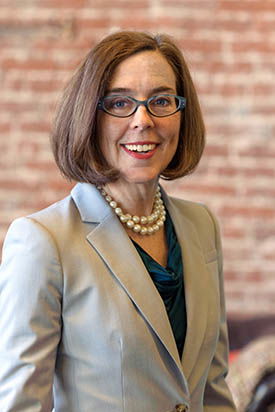 Kate Brown is Oregon’s 38th Governor. From 2008 to 2015, Brown served as Oregon’s Secretary of State, where she was a leader in increasing government transparency and accountability. In that office, Brown oversaw an Audits Division that identified millions in savings by increasing government efficiencies and rooting out waste. She streamlined business registration and licensing by implementing Business Xpress, an online ‘one‐stop shop’ that enables business owners and entrepreneurs to establish and run a business in Oregon without getting bumped around from state agency to state agency.
Brown successfully implemented an online voter registration system, which made it easier for Oregonians to register to vote and saved taxpayer dollars. Oregon received national recognition for Brown’s work utilizing technology to make it easier for active‐duty service members and people with disabilities to vote.
Prior to serving as Secretary of State, Brown served for 17 years in the state legislature: five years in the Oregon House of Representatives and 12 years in the Oregon State Senate. In 2004, Brown made history when she became the first woman in Oregon history to serve as Senate Majority Leader, after being elected by her colleagues.
During her time in the legislature, Kate Brown led efforts on government accountability and reform. In 2007, she successfully spearheaded legislation that The Oregonian called the “state’s most sweeping package of ethics reforms in 34 years.” And she led a bipartisan group of legislators to pass Oregon’s most significant campaign finance reform law in a generation, making campaign contributions more transparent than ever before by creating an online database for campaign finance reporting.
Brown successfully helped pass Family and Medical Leave, making Oregon one of the first states in the nation to allow parents to stay home with their sick children without fear of losing their jobs. She also put Oregon on the map as the first state to require insurance companies to cover annual breast exams for women over 18 as part of preventive health care screenings.
Brown has also been a longtime leader in advancing civil rights and marriage equality. In 2007, she helped to pass the Oregon Equality Act, a civil rights law that prohibited discrimination in employment and housing on the basis of sexual orientation. And Brown was instrumental in passing Oregon’s Family Fairness Act, which legally recognizes committed same-sex relationships as domestic partnerships.
Prior to running for public office, Brown practiced family and juvenile law. She taught at Portland State University, worked with the Juvenile Rights Project and co-founded the Oregon Women’s Health and Wellness Alliance, which has been leading efforts to support women’s health for more than 20 years.
Brown grew up in Minnesota and earned her undergraduate degree from the University of Colorado-Boulder. Kate came to Oregon to attend Lewis and Clark’s Northwestern School of Law, where she received her law degree and Certificate in Environmental Law.
With her husband Dan, Brown raised Dan’s son and daughter, who are now grown, in Portland. When Brown is not busy at the Capitol in Salem, you’ll find her horseback riding or hiking. In February of 2015, Brown and her husband moved into the official residence, Mahonia Hall.
Honorary Doctor of Laws
Symeon Symeonides
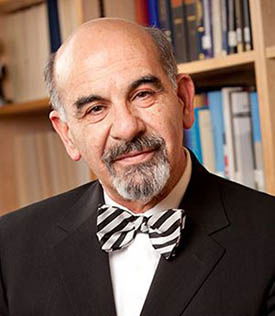 Symeon Symeonides is the Alex L. Parks Distinguished Professor of Law and Dean Emeritus at Willamette’s College of Law. He is also one of the university’s most distinguished and esteemed academics.
Symeonides received his first two law degrees from the University of Thessaloniki in Greece, and the next two (LL.M. and S.J.D.) from Harvard. He joined Willamette in 1999 as Dean of the College of Law and served in that capacity until 2011. Previously, he taught at the University of Thessaloniki, and Louisiana State University, where he was the Judge Albert Tate Professor of Law and vice chancellor. He also taught at the universities of Paris-I (Sorbonne), Paris-V (Descartes), Aix-en-Provence, Louvain-la-Neuve, Tulane, and Loyola, and lectured at The Hague Academy of International Law and more than fifty European and American universities.
Symeonides has published 26 books and more than 120 articles, some of which appear in Chinese, French, German, Greek, Italian, or Spanish. The Stanford Law Review characterized him as a “conflicts giant”. His work has been cited by the supreme courts of the United States, the United Kingdom, and Israel.
His scholarly work has been honored with the Friedrich K. Juenger Prize (2002); the Courtland H. Peterson Senior Scholar Prize (2013) and resolutions of appreciation by the AALS Section of Conflict of Laws. In October 2015, the American Society of Comparative Law selected him for a Life Achievement Award. HeinOnline ranked him 101st on the list of the Top 250 Legal Authors of all time.
Symeonides is president of the International Association of Legal Science, past president of the American Society of Comparative Law and the AALS Section of Conflicts of Laws, titular member of the International Academy of Comparative Law, life member of the American Law Institute and the Groupe Européen de Droit International Privé, member of Phi Beta Kappa and the Order of the Coif, associate member of the Institut de Droit International, and fellow of the European Law Institute.
He is active in law reform. He drafted the Louisiana codification on Conflict of Laws, the Oregon codification for tort conflicts, and a draft Code of Private International Law for Puerto Rico. He spent six months in Brussels, chairing five working groups drafting new laws for the European Union and represented the Presidency of the EU council in negotiating an international convention. He currently serves on an Experts’ Group and a Working Group drafting another convention under the auspices of The Hague Conference on Private International Law, and as an Adviser for the Third Restatement on Conflict of Laws for the ALI. He also provided legislative advice to the EU Parliament and the governments of Cyprus, Estonia, Russia, and Tunisia.
Honorary Doctor of Fine Arts
Marie Watt ‘90
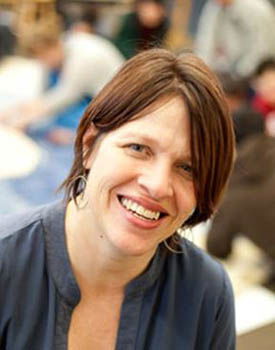 Marie Watt is a nationally-recognized Portland-based mixed media artist whose work explores human stories and ritual implicit in everyday objects.
Watt received her BS degree in Speech Communications and Art from Willamette University in 1990. She went on to earn her MFA degree in painting and printmaking from Yale University in 1996 and has enjoyed a successful career as an artist, teacher, and storyteller. She has been featured in countless solo and group exhibitions over the past 15 years and is included in numerous public and private collections throughout the United States.
She was born to the son of Wyoming ranchers and a daughter of the Turtle Clan of the Seneca Nation (Haudenosaunee), and identifies as “half cowboy and half Indian.” Formally, her work draws from Seneca and Indigenous principles, proto-feminist role models, oral tradition, biography, and history. She explores and reveals the historical and contemporary intersections of Indigenous and Western/European cultures.
Much of Watt’s work is executed in community, notably in “sewing circles,” public events by which anyone with time and interest can participate in making a work, and in which the fellowship and storytelling around the table can be more important than the resulting object. She uses materials that are conceptually attached to narrative: in particular, exploring the stories connected with commonplace woolen blankets, cedar, and iron.
In September 2004, an exhibit of her work opened in New York City at the George Gustav Heye Center of the National Museum of the American Indian. The exhibit included Blanket Stories, a sculpture made of two towers of wool blankets, with each stack sewn together with a central thread. Watt collected the blankets over several years, including many Hudson's Bay point blankets that were given to Native Americans in trade by the Hudson's Bay Company during the 19th century.
In 2011, the Bill & Melinda Gates Foundation commissioned Watt to produce a site-specific artwork for their Seattle campus. The work, Blanket Stories: Matriarch, Guardian and Seven Generations, is a 14-foot column of wool blankets from all over the world and is located in the building's lobby.
One of Watt's blanket columns is now at the Hallie Ford Museum of Art. Another of Watt’s works, created in sewing circles with Willamette faculty, staff and students, hangs in Ford Hall.
Watt is the recipient of numerous awards and fellowships. The book Marie Watt: Lodge offers a comprehensive view of her work and features life stories told through blankets, printmaking, sculpture and digital media.
Honorary Doctor of Science and College of Liberal Arts Commencement Speaker
Jane Lubchenco
Marine ecologist and environmental scientist
 Dr. Jane Lubchenco is a marine ecologist and environmental scientist with expertise in oceans, climate change, and interactions between the environment and human well-being. In 2008 she was nominated by President Obama to be part of his “Science Team." In 2009 she became the first woman to be appointed Under Secretary of Commerce for Oceans and Atmosphere and NOAA administrator, a role she served until 2013.
She received her B.A. in biology from Colorado College, her M.S. in zoology from the University of Washington, and her Ph.D. in ecology from Harvard University. Her academic career as a professor began at Harvard University (1975-1977) and continued at Oregon State University (1977-2009) until her appointment as NOAA administrator.
Dr. Lubchenco is one of the “most highly-cited” ecologists in the world, and eight of her publications are recognized as “Science Citation Classics.” She is an elected member of the National Academy of Sciences; the American Academy of Arts and Sciences; the American Philosophical Society; the Royal Society; and the Academies of Science for the Developing World, for Europe, and for Chile.
Dr. Lubchenco has received numerous awards including a MacArthur “genius” award. She was named 2010 Newsmaker of the Year by the scientific journal "Nature." Her research interests include interactions between the environment and human well-being, biodiversity, climate change, and sustainable use of oceans and the planet.
Visitor in Public Service at Stanford University. In June 2013, she returned to Oregon State University where she is now the Distinguished University Professor and Adviser in Marine Studies. In December 2014, Dr. Lubchenco was one of four scientists selected to serve as a U.S. Science Envoy, a role which will have her engage internationally at the citizen and government levels to develop partnerships, improve collaboration, and forge relationships between other nations and the United States to stimulate increased scientific cooperation and foster economic prosperity.
Honorary Doctor of Humane Letters
William Swindells
Business and community leader
 William Swindells is one of Oregon’s most influential business and community leaders. He has served on Willamette's Board of Trustees since 1971, becoming a Life Member in 2001. Bill served as Chairman of the Willamette University Board of Trustees between 1987 and 1995, and successfully oversaw the Sesquicentennial Campaign during and served as Co-Chair of the Campaign Task Force for Willamette's Capital Campaign during the early 1980s.
Bill majored in engineering at Stanford University, earning his B.S. in 1953. He joined Willamette Valley Lumber Company, which was established by his grandfather in 1905. The company developed into a lumber giant called Willamette Industries. At its peak in the 1990s, Willamette Industries owned or managed 1.7 million acres of timberland and operated more than a hundred wood products manufacturing facilities in twenty-three states and in Ireland, France, and Mexico. Bill served the company in many capacities including: Senior Vice President of Marketing and Building, Executive Vice President, President of the Forest Products Division, President, CEO, and Chairman of the Board (1984-2002).
Bill has been a generous supporter of Willamette University over the years, with major gifts to the Mary Stuart Rogers Music Center, the Swindells Crew Program and the Sparks Center remodel. In 1977, Bill and his family established Willamette University’s Irene Gerlinger Swindells Fund which supported scholarships to undergraduates with interests in music. The Fund also supports an endowed chair, the Irene Gerlinger Swindells Eminent Scholar in Music.
Through the Ann and Bill Swindells Charitable Trust, Bill supports cultural, environmental, and educational organizations throughout Oregon.
Doctor of Humane Letters & College of Liberal Arts Commencement Speaker
Taylor Branch
Author and historian
 Taylor Branch is an American author and historian best known for his landmark narrative history of the civil rights era, "America in the King Years." The trilogy’s first book, "Parting the Waters: America in the King Years, 1954-63", won the Pulitzer Prize and numerous other awards in 1989. Two successive volumes also gained critical and popular success: "Pillar of Fire: America in the King Years, 1963-65", and "At Canaan’s Edge: America in the King Years, 1965-1968". Branch returned to civil rights history in his latest book, "The King Years: Historic Moments in the Civil Rights Movement."
In 2009, Branch published "The Clinton Tapes: Wrestling History with the President." This memoir tells of an unprecedented eight-year project to gather a sitting president’s comprehensive oral history on tape. The collaboration is a story in itself, born of mutual concern over the declining quality of raw material for presidential history. At the initiative of President Bill Clinton, Branch suspended work on the King books about once a month to meet secretly in the White House residence, nearly always late at night. They recorded candid observations for posterity. The book reveals a president up close and unguarded, perceived by an author struggling to balance many roles.
In the October 2011 issue of The Atlantic,Branch published an influential cover story entitled “The Shame of College Sports,” which author and NPR commentator Frank Deford said “may well be the most important article ever written about college sports.” The article touched off continuing national debate. Byliner.com, a pioneer e-book publisher, issued an expanded version of the article as a digital book and on-demand paperback, "The Cartel: Inside the Rise and Imminent Fall of the NCAA."
Branch began his career in 1970 as a staff journalist for The Washington Monthly, Harper’s, and Esquire. He holds honorary doctoral degrees from ten colleges and universities. Other citations include the Dayton Literary Peace Prize Lifetime Achievement Award in 2008 and the National Humanities Medal in 1999.
Doctor of Laws
Kathryn Jones Harrison
Tribal leader and community activist
 Kathryn Harrison is the former Tribal Chairwoman of the Confederated Tribes of the Grand Ronde. She was the first woman to serve in that position. She was born March 28, 1924, the descendant of an Alaskan Native (Eyak) mother Ella and Henry William Jones (Molalla), in Corvallis, Oregon. She graduated from Chemawa Indian School in 1942 and subsequently married Frank Harrison, with whom she had 10 children.
In 1972, she became the first Native American graduate of the nursing program at Lane Community College and started working at Sacred Heart Hospital in Eugene. Eventually, she became an alcohol rehabilitation counselor for the Confederated Tribes of Siletz, where she became instrumental in helping the Siletz Tribe regain federal recognition in 1977. In the early 1980s, Harrison returned to the Tribe of her father – the Confederated Tribes of Grand Ronde – and became instrumental in her second Restoration effort, helping Grand Ronde regain federal recognition in November 1983. Kathryn Harrison, her son, Frank and her daughter, Karen, testified before Congress about restoring the Grand Ronde Tribe, which was terminated in 1954.
Following Restoration, Harrison was elected to the Grand Ronde Tribal Council from April 1984 through September 2001, never losing an election. She served as chair of the Tribal Council for five years, helping to oversee the Tribe’s resurrection from Termination and helping guide the development of gaming as a revenue source to fund Tribal educational, health and cultural efforts.
Harrison, now 90, continues to be an occasional spokeswoman for the Grand Ronde Tribe. Her life was detailed in a book, “Standing Tall: The Lifeway of Kathryn Jones Harrison,” written by Kristine Olson.
Doctor of Science & College of Liberal Arts Commencement Speaker
Dr. Kathryn D. Sullivan
Scientist, first American woman to walk in space
 Dr. Kathryn Sullivan is the Acting Under Secretary of Commerce for Oceans and Atmosphere and Acting Administrator for the National Oceanic and Atmospheric Administration (NOAA). She previously served as Assistant Secretary of Commerce for Environmental Observation and Prediction and Deputy Administrator for NOAA where she played a central role in directing their work in the areas of weather and water services, climate science and services, integrated mapping services and Earth-observing capabilities. She provided agency-wide direction with regard to satellites, space weather, water, and ocean observations and forecasts to best serve American communities and businesses.
An eminent scientist and renowned explorer of space and sea, Dr. Sullivan has made history with her pioneering journeys to the world’s frontiers. She was one of the first six women selected to join the NASA astronaut corps in 1978 and holds the distinction of being the first American woman to walk in space. She flew on three shuttle missions during her 15-year tenure, including the mission that deployed the Hubble Space Telescope.
In 1993, she left NASA to accept a Presidential appointment to the post of Chief Scientist at NOAA where she oversaw a wide array of research and technology programs ranging from climate and global change to satellites and marine biodiversity. Dr. Sullivan has also served on the National Science Board (2004-2010) and as an oceanographer in the U.S. Navy Reserve (1988-2006).
From 1996 to 2006, Dr. Sullivan served as President and CEO of the Center of Science & Industry (COSI) in Columbus, Ohio, one of the nation's leading science museums. Under her leadership, COSI strengthened its impact on science teaching in the classroom and its national reputation as an innovator of hands-on, inquiry-based science learning resources. She also served as the inaugural director of the Battelle Center for Math and Science Education Policy in the John Glenn School of Public Affairs at The Ohio State University, which was established to increase the number of school and university students with strong backgrounds in science, technology, engineering and mathematics.
She holds a bachelor's degree in earth sciences from the University of California at Santa Cruz and a doctorate in geology from Dalhousie University in Canada.
Doctor of Laws
Paul J. De Muniz JD '75
Retired Chief Justice of the Oregon Supreme Court
 In January 2013, Paul De ¬Muniz retired from the Oregon Supreme Court after serving for 12 years, more than six of them as Chief Justice and leader of Oregon’s courts. As Oregon’s top judicial official, De Muniz worked to make the state judicial system more accessible, transparent, accountable, and engaged with the public. De Muniz is the first Hispanic Chief Justice in the history of the Oregon Supreme Court.
He was elected to the court in 2000, and elected as Chief Justice in 2006. De Muniz previously served as a judge on the Oregon Court of Appeals for ten years, worked as an attorney in civil and criminal practice with a Salem firm for 13 years and served as a deputy state public defender.
In 2005 De Muniz wrote and published, “A Practical Guide to Oregon Criminal Procedure and Practice,” a reference about procedural issues that Oregon lawyers and judges are likely to confront in a criminal case. Justice De Muniz's work has been recognized with a number of state and national awards, among them: the National Judicial College's Distinguished Service Award (2009), the National Association of Criminal Defense Lawyers' Judicial Recognition Award, the Oregon Classroom Project's Legal Citizen of the Year Award (2011), the Oregon Area Jewish Committee's Judge Learned Hand Lifetime Achievement Award (2010) and the Edwin J. Peterson Racial Reconciliation Award. In February, 2007 De Muniz was the first recipient of the Oregon Hispanic Bar Association Professionalism Award, which was named in his honor. In 2010, Hispanic Business Magazine named De Muniz among the 100 most influential Hispanics in America. He is a 1975 graduate of the Willamette University College of Law where he was an associate editor of Willamette Law Review. De Muniz was a member of the Willamette University Board of Trustees from 2006 to 2013, serving on the Executive Committee and as chair of the College of Law Committee. He is currently a distinguished jurist in residence at Willamette’s College of Law.
Honorary Doctor of Humane Letters & CLA Commencement Speaker
Dr. Gloria Rodriguez
Founder, national president and CEO of AVANCE, Inc.
 Founder, national president and CEO of AVANCE, Inc. Family Support and Education Program and a national leader on issues of health and education for parents and children. Dr. Rodirguez is a national leader on issues of health and education for parents and children.
AVANCE, the first parenting education program in San Antonio, was recognized nationally as a model for parent education and family support. It promotes mental health and works to prevent poverty, child abuse and neglect, crime and delinquency, school dropouts and other social and economic problems. The program was featured in numerous newspapers and magazines as well as by “ABC World News Tonight,” “Good Morning America,” Univision and Telemundo. AVANCE received the 1985 Outstanding Mental Health Program Award from the Greater San Antonio Mental Health Association, the Third Annual National Award for the Prevention of Child Abuse in 1986 from the Greater Houston Committee for the Prevention of Child Abuse and was included as “one of the ten outstanding and pioneering programs in family literacy” by the Barbara Bush Foundation on Family Literacy.
Dr. Rodriguez served as a charter member on the board of the National Family Resource Coalition and as a consultant to the federal government, the Harvard Family Research Project, Georgetown University and Yale Bush center. She served on the Texas Health and Services Coordinating Council and as chair of the Governor’s Head Start State Collaboration Task Force. Dr. Rodriguez earned her Ph.D. in early childhood education from the University of Texas at Austin.
Honorary Doctor of Science and AGSM Commencement Speaker
Justin Rattner
Corporate Vice President and Chief Technology Officer, Intel Corporation
 Justin Rattner is a corporate vice president and the chief technology officer (CTO) of Intel Corporation. He is also an Intel Senior Fellow and head of Intel Labs where he directs Intel's global research efforts in processors, programming, systems, security, communications and, most recently, user experience and interaction. As part of Intel Labs, Rattner is also responsible for funding academic research worldwide through its Science and Technology Centers, international research institutes, and individual faculty awards.
In 1989, Rattner was named Scientist of the Year by R&D Magazine for his leadership in parallel and distributed computer architecture. In December 1996, Rattner was featured as Person of the Week by ABC World News for his visionary work on the Department of Energy ASCI Red System, the first computer to sustain one trillion operations per second (one teraFLOPS) and the fastest computer in the world between 1996 and 2000. In 1997, Rattner was honored as one of the Computing 200, the 200 individuals having the greatest impact on the U.S. computer industry today, and subsequently profiled in the book Wizards and Their Wonders from ACM Press.
Rattner is a member of the Department of Defense/Department of Homeland Security Enduring Security Framework and serves as a member of its Operations Group. He is a trustee of the Anita Borg Institute for Women and Technology and serves as Intel's executive sponsor for Cornell University where he is a member of the External Advisory Board for the School of Engineering.
Rattner joined Intel in 1973. He was named its first Principal Engineer in 1979 and its fourth Intel Fellow in 1988. Prior to joining Intel, Rattner held positions with Hewlett-Packard Company and Xerox Corporation.
He holds B.S. and M.S. degrees from Cornell University in electrical engineering and computer science.
Honorary Doctor of Science
Dr. Joseph Hooton Taylor, Jr.
American Astrophysicist
 Joseph Hooton Taylor, Jr. (born March 29, 1941) is an American astrophysicist and Nobel Prize in Physics laureate for his discovery with Russell Alan Hulse of a "new type of pulsar, a discovery that has opened up new possibilities for the study of gravitation."
Taylor received a B.A. in physics at Haverford College in 1963, and a Ph.D. in astronomy at Harvard University in 1968. After a brief research position at Harvard, Taylor went to the University of Massachusetts, eventually becoming Professor of Astronomy and Associate Director of the Five College Radio Astronomy Observatory. Taylor's thesis work was on lunar occultation measurements. About the time he completed his Ph.D., Jocelyn Bell discovered the first radio pulsars with a telescope near Cambridge, England. Taylor immediately went to the National Radio Astronomy Observatory's telescopes in Green Bank, West Virginia, and participated in the discovery of the first pulsars discovered outside Cambridge.
Since then, he has worked on all aspects of pulsar astrophysics. In 1974, Hulse and Taylor discovered the first pulsar in a binary system, named PSR B1913+16 after its position in the sky, during a survey for pulsars at the Arecibo Observatory in Puerto Rico. Although it was not understood at the time, this was also the first of what are now called recycled pulsars: neutron stars that have been spun-up to fast spin rates by the transfer of mass onto their surfaces from a companion star.
The orbit of this binary system is slowly shrinking as it loses energy because of emission of gravitational radiation, causing its orbital period to speed up slightly. The rate of shrinkage can be precisely predicted from Einstein's General Theory of Relativity, and over a thirty-year period Taylor and his colleagues have made measurements that match this prediction to much better than one percent accuracy. This was the first confirmation of the existence of gravitational radiation. There are now scores of binary pulsars known, and independent measurements have confirmed Taylor's results. Taylor has used this first binary pulsar to make high-precision tests of general relativity.
Working with his colleague Joel Weisberg, Taylor has used observations of this pulsar to demonstrated the existence of gravitational radiation in the amount and with the properties first predicted by Albert Einstein. He and Hulse shared the 1993 Nobel Prize in Physics for the discovery of this object. He was the James S. McDonnell Distinguished University Professor in Physics from 1980 to his retirement in 2006, and also served for six years as Dean of Faculty.
Honorary Doctor of Humane Letters
Deborah Bial
President and founder of The Posse Foundation,
 Deborah Bial, president and founder of The Posse Foundation, has grown the organization from a concept into one of the most comprehensive college access and scholarship programs in the United States. Since 1989, The Posse Foundation has identified more than 3,000 Posse Scholars. These young people have won $334 million in leadership scholarships, are graduating at a rate of 90 percent, and are leaders on their campuses and in the workforce. The Posse Foundation supports programs in Atlanta, Boston, Chicago, Los Angeles, Miami, New York City and Washington, D.C., and has partnerships with 38 selective institutions of higher education. In October 2007, Bial was honored for her work with a prestigious MacArthur Fellowship from The John D. and Catherine T. MacArthur Foundation.
Bial completed her bachelor’s degree at Brandeis University and earned her master’s and doctorate in education from Harvard University. In 1999, she received a $1.9 million grant from the Andrew W. Mellon Foundation for her dissertation work, which focused on the design and assessment of a new college admissions tool that could be used in addition to traditional college admissions measures.
Honorary Doctor of Humane Letters
Wendy Doniger
Mircea Eliade Distinguished Service Professor of the History of Religions at the University of Chicago
 Wendy Doniger, the Mircea Eliade Distinguished Service Professor of the History of Religions at the University of Chicago, has been called “the greatest living mythologist.” She is a scholar of Hindu religious traditions as well as an editor, translator, novelist and memoirist. Her research and teaching interests revolve around the cross-cultural mythology of death, dreams, evil, horses, sex and women.
She has taught at Harvard, Oxford, the School of Oriental and African Studies at the University of London, and the University of California at Berkeley, and, since 1978, at the University of Chicago. She has been president of the American Academy of Religion, a fellow of the American Academy of Arts and Sciences and president of the Association for Asian Studies. She serves on the International Editorial Board of the Encyclopedia Britannica. She has received several accolades, including: the PEN Oakland literary award for excellence in multi-cultural literature, and the Rose Mary Crawshay Prize from the British Academy for the best book about English literature written by a woman. Doniger has written 16 books, many of which have been translated from Sanskrit to English. She has also published more than 300 articles and many reviews.
Doniger first trained as a dancer under George Balanchine and Martha Graham, and then went on to complete two doctorates in Sanskrit and Indian Studies from Harvard University and Oxford.
Honorary Doctor of Science
Dale T. Mortensen ’61
Ida C. Cook Professor of Economics at Northwestern University and the Niels Bohr Visiting Professor of Economics at Aarhus University
 Joseph Hooton Taylor, Jr. (born March 29, 1941) is an American astrophysicist and Nobel Prize in Physics laureate for his discovery with Russell Alan Hulse of a "new type of pulsar, a discovery that has opened up new possibilities for the study of gravitation."
Dale T. Mortensen ’61 is one of three economists to earn the 2010 Nobel Prize in Economics for their “analysis of markets with search frictions.” The three men pioneered a theory that helps explain why people remain unemployed despite many job vacancies. The model can be used to estimate how unemployment benefits, interest rates, the efficiency of employment agencies and other factors affect the job market. Mortensen’s insight has become the leading technique for analysis of labor markets and the effects of labor market policy. His publications include more than 50 scientific articles.
Mortensen is the Ida C. Cook Professor of Economics at Northwestern University and the Niels Bohr Visiting Professor of Economics at Aarhus University. Mortensen is a fellow of the Econometrica Society, the American Academy of Arts and Sciences, the Society of Labor Economics and the European Economic Association. He was awarded the IZA Labor Economics Prize in 2005 and the Society of Labor Economics Mincer Prize in 2007. In 2008, he was elected an American Economic Association Distinguished Fellow. Mortensen received his bachelor’s degree in economics from Willamette University and his PhD in economics from Carnegie-Mellon University.
Honorary Doctor of Humane Letters-Awarded September 2010
Nobuyasu Kurata
Chancellor of the Kaneko Educational Foundation
 Nobuyasu Kurata was named as chair and chancellor of the Kaneko Educational Foundation in September 2009, expanding his leadership to both Tokyo International University and Tokyo International University of America. Chancellor Kurata taught at Daito Bunka University for more than 20 years before being named vice chairman of the Kaneko Educational Foundation (Tokyo International University) in 2001. He received professor emeritus status from Daito Bunka University in 2002.
Chancellor Kurata received his bachelor of arts in Chinese literature from Daito Bunka University. He is the author and co-author of more than 30 published research papers and scholarly treatises on topics relating to Chinese philosophy, ancient Chinese thought and Japanese thought.
Chancellor Kurata was presented with his honorary degree from Willamette University in September 2010 when President Pelton traveled to Japan.
Honorary Doctor of Humane Letters & CLA Commencement Speaker
Scott Simon
NPR Host, Writer & Novelist
 Peabody-award-winning Scott Simon is host of one of National Public Radio’s most popular programs: Weekend Edition Saturday. He is also currently reporting for BBC News. He has reported from all 50 states and every continent. He has covered 10 wars, hundreds of campaigns, sieges, famines, hurricanes, earthquakes, civil wars, scandals, state funerals and opening nights. He has interviewed and profiled some of the most interesting personalities of the times, from Mother Teresa to Ariel Sharon and Wyclef Jean, to roving street kids in Rio, and refugees in Kosovo, Ethiopia and Sudan.
Simon has received numerous honors for his reporting, including the Overseas Press Club, Alfred I. duPont-Columbia University, George Foster Peabody, Ohio State, Directors Guild, Major Armstrong, and Emmy awards. He received a special 1989 George Foster Peabody Award for his weekly essays, which were cited for their sensitivity and literary style. He was awarded the Studs Terkel Media Award in 2009.
Simon has written for The New York Times Book Review and Op-Ed pages, the Wall Street Journal opinion and book page, The Los Angeles Times, Friends Journal, and Gourmet Magazine (his Gourmet article on “Conflict Cuisine” recently won the International Culinary Professionals Award). He is also the author of two novels: Pretty Birds, his novel about teenage girls during the siege of Sarajevo, and Windy City, a political comedy that was chosen by the Washington Post as one of the best novels of 2008. He attended the University of Chicago and McGill University and has received numerous honorary degrees. Photo Credit Will O'Leary
Honorary Doctor of Humane Letters
Professor Sarah Hrdy
Anthropologist
 Sarah Blaffer Hrdy, professor emerita at the University of California, Davis, spent years researching how various evolutionary pressures shape primate behavior.
A former Guggenheim fellow, she has been elected to the California Academy of Sciences, the National Academy of Sciences and the American Academy of Arts and Sciences.
She is the author of five books including The Black-man of Zinacantan: A Central American Legend (1972); The Langurs of Abu: Female and Male Strategies of Reproduction (1977) the first book to examine the reproductive strategies of nonhuman primates from the perspective of both sexes; The Woman that Never Evolved (1981, new edition 1999) selected by the New York Times as one of the Notable Books of the Year; and Mother Nature: A history of mothers, infants and natural selection (1999), which won the Howells Prize for Outstanding Contribution to Biological Anthropology and was chosen by both Publisher’s Weekly and Library Journal as one of the “Best Books of 1999”, and Mothers and Others: The evolutionary origins of mutual understanding (Belknap Press of Harvard, spring 2009), a book about cognitive and emotional implications of humankind’s deep legacy of cooperative breeding. She is also co-editor of Infanticide: Comparative and Evolutionary Perspectives, selected by Choice as one of the “Outstanding Academic Books” for 1984, and co-editor with Sue Carter and others of Attachment and Bonding: A new Synthesis (2005). For many years she edited the Foundations of Human Behavior series from 1985-96 and continues to serve on editorial boards for Evolutionary Anthropology and Human Nature.
Hrdy graduated summa cum laude from Radcliffe College and received her Ph.D. from Harvard University. She and her husband currently combine growing walnuts with habitat restoration on their farm in northern California.
Honorary Doctor of Science
Dr. Robert Langer
Scientist/Engineer
 Robert Langer is the David H. Koch Institute Professor (there are 14 Institute Professors at MIT, which is the highest honor that can be awarded to a faculty member). He is head of the Langer Lab that studies and develops polymers to deliver drugs.
Dr. Langer has written approximately 1,050 articles. He also has approximately 750 issued and pending patents worldwide. Dr. Langer’s patents have been licensed or sublicensed to over 220 pharmaceutical, chemical, biotechnology and medical device companies.
Dr. Langer has received over 170 major awards including the 2006 United States National Medal of Science; the Charles Stark Draper Prize, considered the equivalent of the Nobel Prize for engineers, and the 2008 Millennium Prize, the world’s largest technology prize. He is the also the only engineer to receive the Gairdner Foundation International Award.
Forbes Magazine (2002) selected Dr. Langer as one of the 15 innovators worldwide who will reinvent our future. Time Magazine and CNN (2001) named Dr. Langer as one of the 100 most important people in America and one of the 18 top people in science or medicine in America (America’s Best). Parade Magazine (2004) selected Dr. Langer as one of 6 “Heroes whose research may save your life.” He received his bachelor’s degree from Cornell University and his Sc.D. from the Massachusetts Institute of Technology, both in chemical engineering.
Honorary Doctor of Humane Letters
Juan Williams
Journalist, Senior Correspondent, and Political Analyst
 Juan Williams, one of America’s leading journalists serving as National Public Radio’s senior correspondent and as a political analyst for the Fox News Channel, including regular appearances on Fox News Sunday.
During his 21-year career at The Washington Post, Juan Williams served as an editorial writer, op-ed columnist, and White House reporter. He has won an Emmy award for TV documentary writing and won widespread critical acclaim for a series of documentaries including “Politics - The New Black Power.”
Articles by Juan Williams have appeared in magazines such as Newsweek, Fortune, and The Atlantic Monthly. He has also appeared on numerous television programs, including Nightline, Washington Week in Review, Oprah, CNN's Crossfire (where he frequently served as co-host), and Capitol Gang Sunday. Juan Williams will deliver the CLA commencement address.
Honorary Doctor of Humane Letters
Dr. Bernice Johnson Reagon
Professor Emeritus of History
 Honorary Doctor of Humane Letters to Bernice Johnson Reagon, who for more than 45 years has been a major cultural voice for freedom and justice – singing, teaching and speaking out against racism and organized inequities of all kinds.
She recently retired after 30 years of performing with Sweet Honey In The Rock, the internationally renowned a cappella ensemble she founded in 1973. She produced most of the groups recording including the Grammy nominated Still The Same Me.
Her work as a scholar and composer is reflected in numerous publications and productions on African American culture and history.
Dr. Reagon is professor emeritus of history at American University and was the recipient of the 2003 Heinz Award for the Arts and Humanities for her work as a scholar and artist in African American cultural history and music.
Honorary Doctor of Humane Letters
Timothy Egan
Author
 Timothy Egan worked for 18 years as a writer for The New York Times, first as the Pacific Northwest correspondent, then as a national enterprise reporter. In 2006, Egan won the National Book Award, considered the nation’s highest literary honor, for his history of people who lived through the Dust Bowl, The Worst Hard Time, which also became a New York Times bestseller. In 2001, he won the Pulitzer Prize as part of a team of reporters who wrote the series “How Race is Lived in America.” He has done special projects on the West and the decline of rural America, and he has followed the entire length of the Lewis and Clark Trail.
Egan is the author of five books, including The Good Rain: Across Time and Terrain in the Pacific Northwest, The Winemaker’s Daughter and Lasso the Wind, Away to the New West. A graduate of the University of Washington, Egan also holds an honorary doctorate of letters from Whitman College. A third-generation Westerner, Egan lives in Seattle.